
Dom Rodrigo: the Algarve sweet you unwrap like a candy
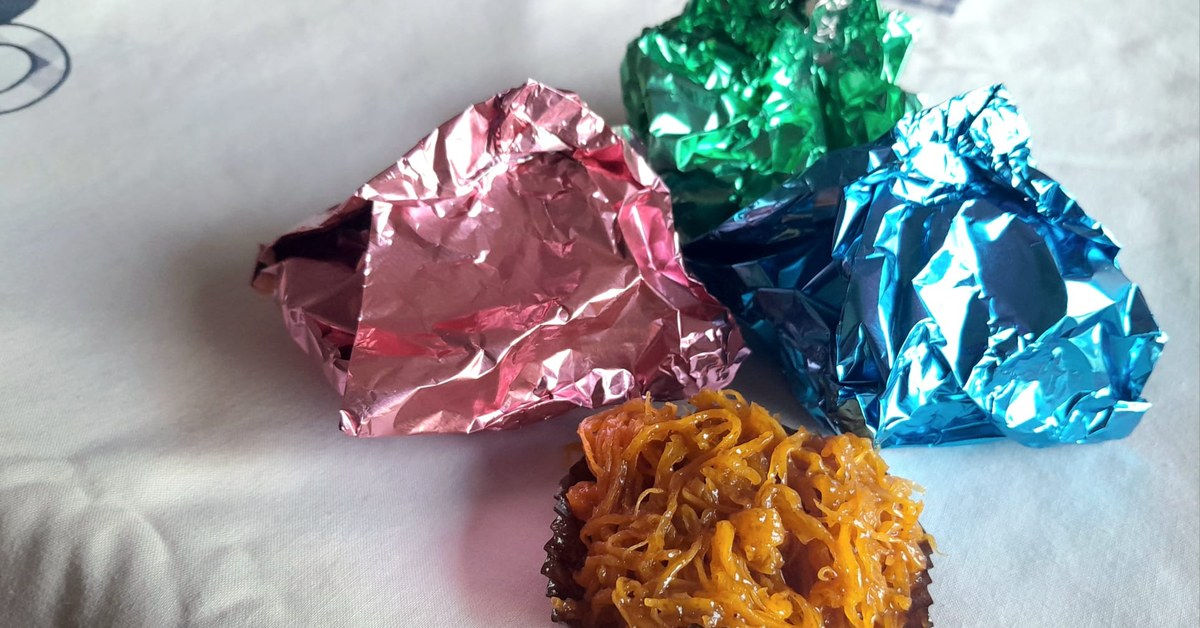
A rustle first. Two corners of metallic paper eased open with your fingertips, the sound of a Christmas candy, and there it is: golden brown, glossy, sticky, dusted with cinnamon. Dom Rodrigo is the only Portuguese sweet you unwrap before eating it, and that detail, which looks like mere packaging, tells you most of its story.
A sweet that arrives dressed
On market stalls across the Algarve, Dom Rodrigos pile up in colours: silver, gold, red, green, blue. Each one is a crinkled little pyramid, or a ball held in paper twisted shut at both ends. At first glance they look like factory confectionery. They are doces conventuais, convent sweets, and among the oldest in southern Portugal.
The wrapping is not decorative. Under the metallic sheet lies a square of greaseproof paper, and under that, a paste that weeps sugar and sticks to everything it touches. Without that double layer, Dom Rodrigo would be unsellable at a market: it has to be held, carried, stacked. The paper solved a pastry problem, not a styling one.
Lagos, a convent, a governor
The recipe goes back to the 18th century, to Lagos, to the former convent of Nossa Senhora do Carmo. The Carmelite nuns there made, as in every Portuguese convent of the period, sweets built on egg yolks: the whites went elsewhere, to clarify wine or stiffen cloth, and the yolks stayed behind.
The name comes from a man: D. Rodrigo de Menezes, governor of the fortress of Lagos, in whose honour the sweet is said to have been created. In the 19th century, when Portugal's convents closed, the recipe left the walls and passed to a family in Lagos, who handed it down from one generation to the next. It is the classic path of Portuguese convent baking: born behind a grille, saved by a family, turned into the emblem of a region.
What sits under the paper
Dom Rodrigo is an assembly, not a single batter. Inside you find:
- fios de ovos, those egg threads drawn from yolk into boiling syrup, which give the stringy texture and the shine;
- a mass of ovos-moles, that is egg yolks and sugar syrup cooked together until they thicken;
- almond, from the Algarve, for fat and body;
- cinnamon, ground, on top and within.
All of it is rolled into a ball, then toasted directly in the pan: that step, and not any added caramel, is what gives the golden-brown colour and the roasted taste. The traditional product specification is explicit about it: industrial caramel has no place here. The colour must come from heat, not from a bottle.
If the egg threads intrigue you, they have a history of their own, and it runs through Asia: we told it in our article on fios de ovos.
The paper is younger than the recipe
Here is the paradox: the sweet is more than two centuries old, its costume far less. The wrapping we know today arrived with aluminium foil, in the 20th century. It was silver at first — hence the memory, for many Portuguese, of a sweet "in silver paper" — and then the colours came, so that makers could tell themselves apart on the market stalls.
The result: a whole generation associates Dom Rodrigo with a metallic rustle the Carmelites of Lagos never heard. That is often how old recipes survive: they change clothes in order to stay alive.
A mouthful of the Algarve
Dom Rodrigo is made in the municipalities of the Faro district, which is to say across the whole Algarve. The geography is no accident: this is almond country, where the orchards turn white in February, and fig and carob country too. The entire doçaria of the south turns around those three trees.
You meet the same almond, worked differently, in the morgado of the Algarve, where it is sculpted by hand together with dried fig. Two neighbouring sweets, two opposite gestures: one is modelled, the other rolled and hidden.
The taste, honestly
It has to be said: Dom Rodrigo is blunt. Very sweet, very eggy, very cinnamon. This is not a pastry you eat three of. In Portugal you take one after coffee, often standing up, and then you go. Its size, that of a large walnut, is as much a warning as a portion.
Served fresh, barely warmed by your hand, it comes apart in threads in the mouth, and the cinnamon arrives last. It is a festive dessert, the close of a family meal, something brought home from the market. Rarely an afternoon snack.
At Wooly, in Brussels
We do not make Dom Rodrigo in our workshops, but this whole family of sweets, the one built on egg yolks, syrup and almond, is what we work with every morning. Our coconut or almond eggs come from exactly that lineage: same base, same patience, same way of letting the egg do the work. If you want to understand Portuguese doçaria in a single bite, that is where to begin, on rue des Tongres in Etterbeek, in Stockel, in Uccle or in Waterloo. Addresses and opening hours are on the page of our four Brussels shops.
And if one day, at a market in the Algarve, you spot a heap of crinkled papers glinting in the sun: those are the ones. Pull at the two corners.
Photo: Dom Rodrigo, by Cardoazul — Wikimedia Commons, licence CC BY-SA 4.0.
Read next
Uvada: the harvest sweet they boiled at night, without sugar
There is no sugar in uvada. Not a gram. This Portuguese harvest sweet draws all of its sweetness from the grape itself,…
Tigelada: the dessert baked in the village bread oven, after the bread
The oven has just given up its bread. The vault is still glowing, the embers pushed to the back: that exact moment is…
Brisas do Lis: the Leiria cake that had to change its name
They were called the little kisses of the Lis, until the jokes at the counter forced Leiria to find another name. The…
Ceylon cinnamon: the bark the Portuguese found by accident
On a pastel de nata that is still warm, it comes last, in a gesture lasting one second. Yet this brown powder has…
Alfarroba: the Algarve's black gold, harvested with a long pole
In late August, in the hills behind the Algarve coast, you hear it long before you see anything: a dry, repeated…
Papos de anjo: the egg-yolk cake that is cooked twice
It leaves the oven baked, golden and domed — and yet the work is not finished. The papo de anjo goes straight into a…
Jesuíta: the crackling triangle Santo Tirso guards so fiercely
Some pastries announce themselves by sound. The jesuíta of Santo Tirso starts with a thin crust of sugar that gives way…

Pastel de Chaves: the recipe bought from a stranger in 1862
A half-moon of puff pastry, a veal filling, and a recipe bought for one pound from a street seller whose name nobody…
Find our artisan pastries in our Brussels stores or order online.
Order now Our foodtruck for your events Our stores