
Uvada: the harvest sweet they boiled at night, without sugar
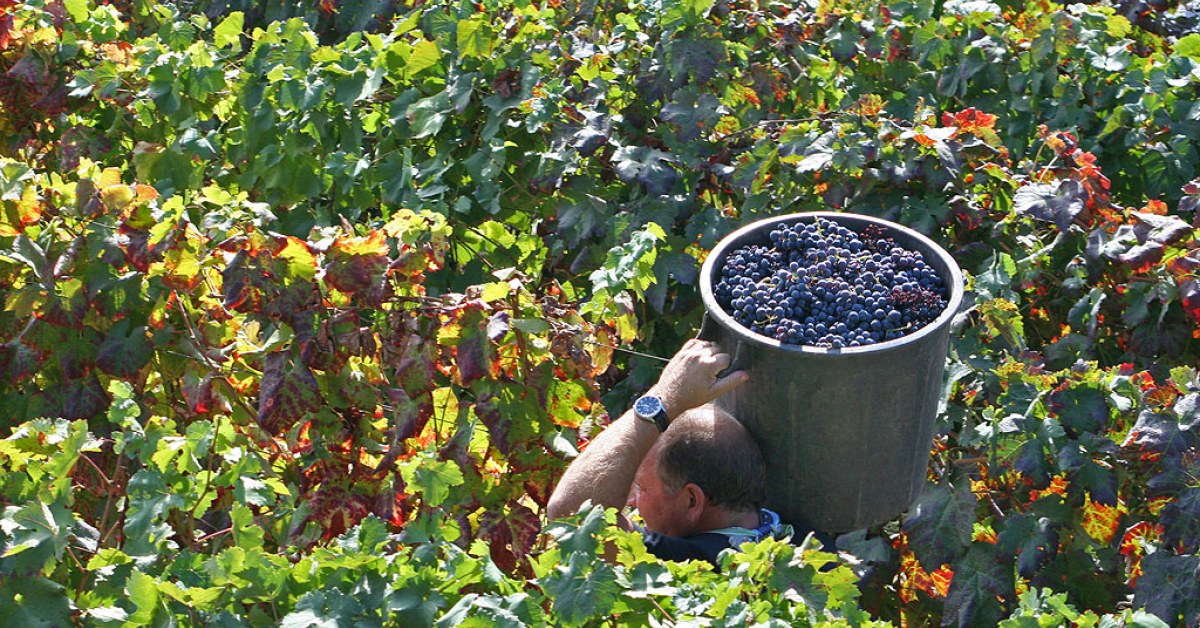
Night has fallen on a courtyard in the Portuguese Oeste. A wire cauldron sits on a trivet over a wood fire. Inside: grape juice, pressed that same morning. It will boil for hours. Nobody goes to bed before it turns the colour of ink.
What is simmering there is called uvada. It is a harvest sweet, and it may be one of the very few Portuguese confections you can honestly describe as containing nothing but what the vine gave.
A sweet without sugar, because there was no sugar
The principle fits in a sentence: you boil grape must until only a third of it is left. The liquid thickens, darkens, concentrates. The sugar in the grape does not go anywhere: it simply draws in on itself. What you are left with is a dark, dense paste you can spread.
That concentrate has a name of its own: arrobe, also written arroube, arrobo or arroubo depending on the village. The word comes from the Arabic ar-rub — fruit juice, syrup. Which tells you how old the gesture is: people were doing this well before sugar became an ordinary commodity in Portugal. Uvada did not choose to go without sugar. Uvada is older than sugar.
In the Oeste, the sub-region in the centre of the country where wine and fruit are grown but where honey never had much of a tradition, uvada served a very concrete purpose: it replaced butter on bread, all year round. It also went into papas de milho, cornmeal porridge. This was not a celebration dessert. It was the everyday sweetness.
Grapes, apples, cinnamon
The traditional recipe rests on three things: the juice of properly ripe grapes, the higher in sugar the better, apples of assorted varieties, and cinnamon. The grape varieties named are the ones from the region: Fernão Pires, Periquita, Santarém.
The work starts with the harvest itself, then the crushing and the drawing off of the must. While it reduces, you patiently skim the residue that rises to the surface. Only then does the cut fruit go in. And not only apples, depending on the household: figs, pears, peaches, melon, added in equal parts with the must.
Then you let it go. For a long time. Until the mass turns very dark brown, close to black. Which leaves the question of when to stop, and there is no thermometer for that: you spoon a little of the sweet onto a plate and draw a line through it with a finger or a spoon. If the furrow holds, if the edges do not close back over it, it is ready. This is called ponto estrada, the "road point". The road has to stay visible.
Two houses, two uvadas
This is where uvada becomes more than a recipe. It was made in two quite distinct settings, and the difference between them tells you about an entire society.
The first: at the end of the harvest, in the house of the patrão, the landowner. Some of the women workers were then assigned to the kitchen to make the uvada. An allotted task, indoors, in a proper kitchen.
The second: during the harvest, in the homes of families with less. There, uvada was made after the jorna, after the paid working day. So, at night. And not in a kitchen: outside, in the street or in the yard, the wire pot set on a trivet over a wood fire.
It is worth pausing on what that involves. You have picked grapes all day. You come home. And instead of sleeping, you light a fire in the yard to watch a pot reduce for hours. Because the must cannot wait until tomorrow, and because that one pot is the sweetness of the entire year ahead. Uvada keeps from one year to the next. It was not a treat. It was a store.
A cousin in almost every wine country
The unsettling thing about uvada is that it does not stand alone. Everywhere wine has been made, somebody worked out that you could boil must down into sugar.
- in Spain, arrope;
- in France, raisiné;
- in Italy, sapa or mosto cotto;
- in Switzerland, vin cuit;
- in Turkey, pekmez;
- in Iran, shire angoor;
- in Cyprus, épsima;
- and as far as Chile, Argentina and Bolivia, where it is still called arrope.
The same gesture, the same fire, the same patience, across thousands of kilometres. Portuguese uvada is credited with at least two thousand years of transmission from one generation to the next. Looking at that map, it does not sound far-fetched.
This year, the harvest is early
In the Douro, the first bunches were cut earlier than usual: the vines ran ahead of schedule and picking began one to two weeks before the normal calendar. Portugal's institute for vine and wine expects the 2026-2027 campaign to come in around 6.7 million hectolitres, roughly 12 % up on the previous one.
Which means that right now, across Portugal, there is must everywhere. That is precisely the uvada window: September, October, for as long as the vindima lasts. Miss it and you wait a year.
What it tells us, from Brussels
We do not make uvada in our workshop: it is a country sweet, tied to a must that has to be cooked the day it is pressed. But we recognise the logic. The cinnamon that perfumes uvada is the same one we dust over a pastel de nata as it comes out of the oven; we even gave it an article of its own, so long is its Portuguese history. And that idea of not rushing the bake, of waiting for the right point rather than for the clock, is exactly the idea behind pão de ló, which comes out of the oven to the second. When you push open the door of one of our shops — Rue des Tongres in Etterbeek, Stockel, Uccle or Waterloo — it is that same slow-cooked Portugal waiting inside.
In the Oeste, many families still bring out the pot of uvada at Christmas and set it on the table. A year after that night in the yard. Perhaps that is the real recipe: something you make when you are exhausted, for someone who will eat it a long time from now.
Photo: Alegna13, “Vindima em Santa Marta de Penaguião”, Wikimedia Commons, licence CC BY-SA 3.0.
Read next
Tigelada: the dessert baked in the village bread oven, after the bread
The oven has just given up its bread. The vault is still glowing, the embers pushed to the back: that exact moment is…
Brisas do Lis: the Leiria cake that had to change its name
They were called the little kisses of the Lis, until the jokes at the counter forced Leiria to find another name. The…
Ceylon cinnamon: the bark the Portuguese found by accident
On a pastel de nata that is still warm, it comes last, in a gesture lasting one second. Yet this brown powder has…
Alfarroba: the Algarve's black gold, harvested with a long pole
In late August, in the hills behind the Algarve coast, you hear it long before you see anything: a dry, repeated…
Papos de anjo: the egg-yolk cake that is cooked twice
It leaves the oven baked, golden and domed — and yet the work is not finished. The papo de anjo goes straight into a…
Jesuíta: the crackling triangle Santo Tirso guards so fiercely
Some pastries announce themselves by sound. The jesuíta of Santo Tirso starts with a thin crust of sugar that gives way…
Pastel de Chaves: the recipe bought from a stranger in 1862
A half-moon of puff pastry, a veal filling, and a recipe bought for one pound from a street seller whose name nobody…

Leite-creme: the red-hot iron that cracks Portuguese custard
You hear it before you taste it: the spoon presses, the sugar crust gives way with a dry crack, and underneath there is…
Find our artisan pastries in our Brussels stores or order online.
Order now Our foodtruck for your events Our stores