
Brisas do Lis: the Leiria cake that had to change its name
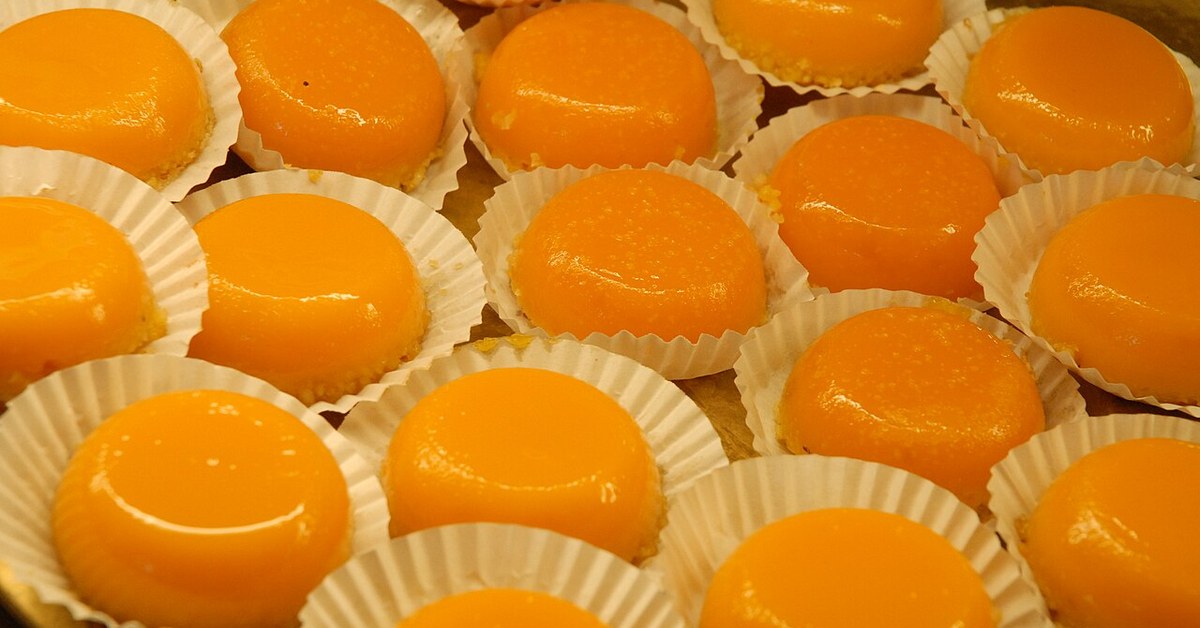
You spot them by their jacket first: a small pleated paper case, a deep yellow dome, almost orange, that barely trembles when the spoon touches it. You brace for a dry mouthful of almond. It is the opposite: egg, sugar and almond have melted into a single substance, dense, cool, faintly sticky against the palate.
The pastry is called brisa do Lis, plural brisas do Lis — you will also see the older spelling Liz. It comes from Leiria, a town in central Portugal between Lisbon and Coimbra, and it takes its name from the river running through it.
A river, a town, a name
The Lis comes down from the inland hills, passes below Leiria's castle and heads for the Atlantic. Locals say rio Lis, and the town happily calls itself the cidade do Lis. Naming a pastry after a river is no small thing in Portugal: it is a way of saying it belongs to no one else, that it was born there and nowhere else.
The word brisa simply means breeze. A remarkably gentle name for such a rich little cake. It was not, however, the first one.
Before the brisas came the beijinhos
The original name was beijinhos do Liz: little kisses of the Lis. The word says exactly what it means: a mouthful that fits in the hand, eaten in one go, given rather than sold.
Except you had to order it out loud, at the counter, in front of everyone. Asking the woman behind the display for a beijinho got the whole room laughing, and the jokes stuck to the cake. In Leiria they will tell you that is why the name changed, and for no other reason: the beijinhos became brisas. The kiss turned into a breeze. The cake itself did not shift by a gram.
It is a counter story, the kind passed on without any archive. Still, something in it rings true: Portuguese pastry names are rarely descriptive. They are affectionate, teasing, sometimes frankly irreverent — papos de anjo, angel's jowls, toucinho do céu, bacon from heaven, barrigas de freira, nun's bellies. Nobody minds, except when the words have to be said aloud.
Two accounts that refuse to agree
On the origin of the recipe, Leiria has never settled the matter. Two versions circulate, and neither is established.
The first is the one you hear most: the brisas are said to come from the convento de Santana, a Leiria convent long since demolished. The nuns are supposed to have developed the recipe, before a woman who attended services there was entrusted with the secret. That version places the brisas in the long line of doces conventuais, the convent sweets built on egg yolk and almond that Portugal turned into a national speciality.
The second version is more recent and more down to earth: two women from Leiria who left for Angola in the early twentieth century are said to have perfected the recipe there and brought it home. Their friendship became a business, and that business one of the busiest cafés in town. Both accounts have their supporters; the Portuguese sources that carry them admit that neither has been proven.
That is common, and it does no harm. A pastry recipe leaves no archive: it leaves gestures, handed from kitchen to kitchen, quietly, by people who did not write. What remains verifiable is the cake itself.
Three ingredients, no room to hide
The base never varies: egg yolks, sugar, ground almonds. Some houses add a little butter. That is all, and that is exactly what makes it unforgiving: with three ingredients there is nothing to hide behind.
- The sugar is first taken to syrup, to the precise point where it coats without yet spinning a thread.
- The ground almond goes in while the syrup is hot, so it releases its oil instead of staying powdery.
- The yolks come last, off the heat; past a certain temperature they set and the mixture turns grainy.
- Baking happens in small individual moulds, in a bain-marie: that gentle, humid heat firms the mass without drying it.
- Unmoulding is done cold, into a pleated paper case that follows the cake all the way to the plate.
The result is neither a custard nor a biscuit. It is a substance of its own, somewhere between marzipan and set cream, eaten with a teaspoon and kept cool.
The wide family of yolk and almond
The brisas are not alone. A whole branch of Portuguese pastry rests on that pairing, for a very practical reason: convents used enormous quantities of egg white — to starch linen, to clarify wine — and were left with yolks by the hundred. Something had to be done with them.
Out of that constraint grew an entire repertoire. Toucinho do céu, an almond and yolk cake named after an ingredient it no longer contains. The meias-luas of Viana do Castelo, once bought at a wooden turntable without ever seeing the nun who passed them through. The brisas do Lis belong in that family, with their bite-size format and their name like a draught of air.
And in Brussels?
At Wooly the same logic runs all year: the yolks go into the custard of the pastéis de nata, the whites find their use elsewhere. Our coconut or almond eggs belong to exactly that kinship: same small format, same paper case, same density that surprises at the first spoonful. We are happy to talk about it over the counter on rue des Tongres in Etterbeek, as in our shops in Stockel, Uccle and Waterloo: in Brussels too, Portuguese pastry is as much told as tasted.
And should anyone ask you for a beijinho across the display case, know that in Leiria the question once made an entire town laugh.
Photo: Sandra Costa, Wikimedia Commons, licence CC BY-SA 4.0.
Read next
Ceylon cinnamon: the bark the Portuguese found by accident
On a pastel de nata that is still warm, it comes last, in a gesture lasting one second. Yet this brown powder has…
Alfarroba: the Algarve's black gold, harvested with a long pole
In late August, in the hills behind the Algarve coast, you hear it long before you see anything: a dry, repeated…
Papos de anjo: the egg-yolk cake that is cooked twice
It leaves the oven baked, golden and domed — and yet the work is not finished. The papo de anjo goes straight into a…
Jesuíta: the crackling triangle Santo Tirso guards so fiercely
Some pastries announce themselves by sound. The jesuíta of Santo Tirso starts with a thin crust of sugar that gives way…
Pastel de Chaves: the recipe bought from a stranger in 1862
A half-moon of puff pastry, a veal filling, and a recipe bought for one pound from a street seller whose name nobody…
Leite-creme: the red-hot iron that cracks Portuguese custard
You hear it before you taste it: the spoon presses, the sugar crust gives way with a dry crack, and underneath there is…
Pudim Abade de Priscos: the Portuguese pudding with no milk
A dark, dense Portuguese pudding born in a presbytery near Braga, whose original recipe contains not a drop of milk.…

Fios de Ovos: The Portuguese Egg Thread That Conquered Siam
Egg yolk falling in a thin stream into boiling syrup, and coming out as golden thread. Fios de ovos may be the most…
Find our artisan pastries in our Brussels stores or order online.
Order now Our foodtruck for your events Our stores